





Logo-quarksUp
Logo-quarksUp
< Retour au blog

Training plan: definition and model

Maxime Ponsar
October 20, 2025
Table of Contents

Today, as a key factor in retaining talent, the training plan has evolved into a skills development plan. It is a driving force behind employee engagement that must be taken seriously.

In addition, it enables employers to adapt to changes in the nature of their work and in the business environment of their industry.

As this strategy combines corporate objectives with employee expectations, you are largely responsible for managing it.

Looking for a training plan template? We have one for you... But first, let’s go over a few details.

What is a training plan or skills development plan?

Since January 1, 2019, the training plan has evolved into the skills development plan.

Why?

To simplify it, making it both more tailored and more flexible. The “Freedom to Choose One’s Professional Future” Act of September 5, 2018, reformed the system accordingly. The goal: to shift from a system that prescribed a set of training programs to be completed to a framework that outlines the skills to be acquired by the company.

Muriel Pénicaud, Minister of Labor in 2018, summed up this idea well: “Boldness means transforming reality to equip ourselves to seize the full potential of the changes to come. “With 50% of jobs set to undergo profound transformation over the next ten years, this requires, more than ever, simpler, faster, and fairer access to the major asset of the 21st century: skills.”

The skills development plan is therefore an HR management tool that should be tailored to the company’s strategy and its projects.

To this end, training programs can take various forms:

  • In-person or online training 
  • AFEST (On-the-Job Training) 
  • Tutoring 
  • Seminar 
  • Work-study program 
  • Skills Assessment 
  • VAE (Recognition of Prior Learning)

Beyond its strategic aspect, it is also a valuable tool for improving employee engagement.

Request a demo

Who is affected by the skills development plan?

  1. The employer is directly involved in the company's skills development plan. They are often the initiator, and the employee is the main actor. The employer and, by extension, you, the HR department. All organizations, regardless of their size, can develop a skills development plan. Its implementation depends on management after consultation with the social and economic committee (CSE) if the company has more than 50 employees. There is no legal obligation regarding the training plan. However, pursuant to Article L 6321-1 of the Labor Code, the employer is required to adapt its employees to their positions and maintain their employability. The creation of a training plan therefore constitutes proof of the actions taken to contribute to this obligation.
  2. The Social and Economic Committee. It is consulted on the company's strategic directions each year. The SEC therefore has a say in the direction of staff training. It ensures that decisions are based on both the economic and social vision of the company.
  3. Employees. All employees, even those on work-study programs (apprenticeship contracts, professional training contracts), are eligible for this plan. They can request to participate in an apprenticeship program included in the skills development plan. The request and response are made freely, and the employer is free to refuse or accept.

How to create a skills development plan for your company?

In practical terms, how do you develop a skills development plan? Simply by following these steps:

  • Identify strategic skill needs for the company;
  • Gather employee expectations regarding training;
  • Study the possibilities and the means to be put in place;
  • Prioritize and budget actions to develop a draft skills development plan;
  • Consult and present your plan to the Works Council;
  • Inform staff of its implementation;
  • Assess its impact.

Of course, the project may evolve as it is developed, due to new priorities or new employees, for example. It is, above all, a forward-looking tool and should not be viewed as a rigid constraint. 

For greater flexibility, our software is capable of fully managing the entire process. Our training management software offers:

  • Centralize training requests 
  • Manage the plan in real time 
  • Automate administrative tasks (registration, invitations, attendance sheets, etc.).

Bringing every step together in one place—from implementation to evaluation—will make your job much easier.

Request a demo

Skills development plan template

Our competency development plan template is designed to clearly show you the information you need to implement it.

Example of a training plan:
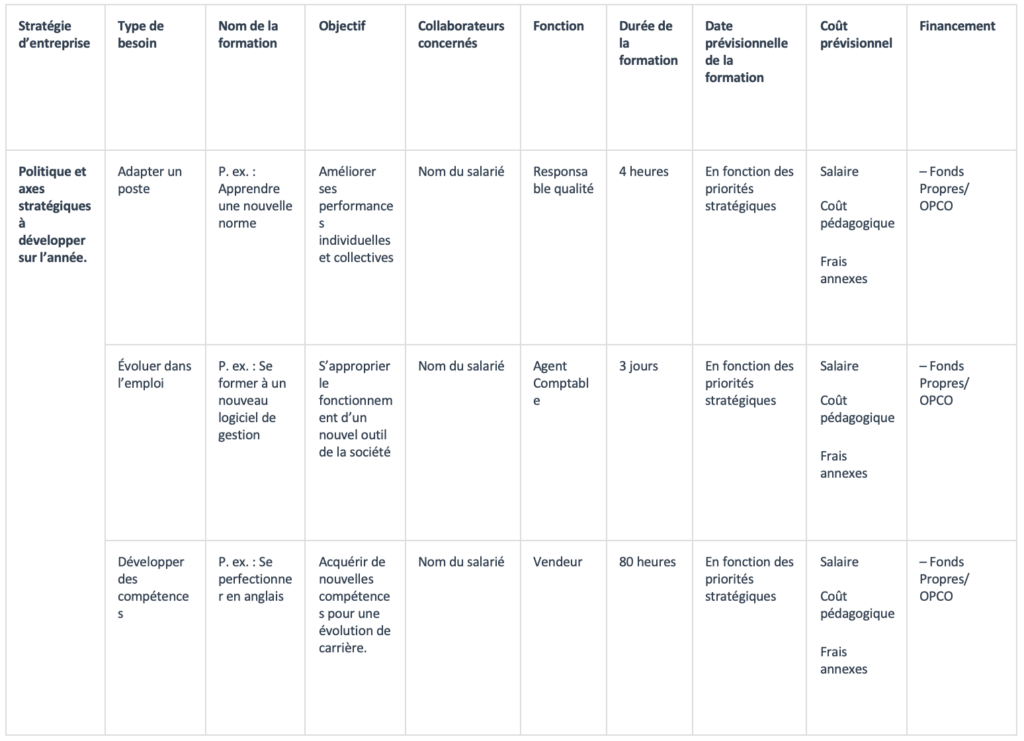
Your document should clearly and simply outline the requirements. As indicated in the first column, the starting point is always your business strategy. Next come three main categories of training:

  1. Job suitability 
  2. Career advancement or job retention 
  3. Skills development

The 3 key points to remember:

  1. The skills development plan has become a strategic HR tool for the company.
  2. Its creation is achieved through the joint efforts of all members of society;
  3. Management can be simplified using our QuarksUp solution.

Cookie PolicyLegal noticesPrivacy Policy
Copyright © 2025, quarksUp. All rights reserved.