










Employee engagement has become a key performance indicator. But it is still necessary to know what we are actually measuring. Employee engagement software makes it possible to assess the level of involvement of teams, identify weak signals, and take targeted action.
In 2026, the most advanced companies will no longer be satisfied with one-off barometers: they will cross-reference employee feedback with observable behaviors and data from HR processes (mobility, training, career paths, interviews) to manage engagement in a sustainable way, particularly in mid-sized companies.
In summary:
In a company,employee engagement has a direct and measurable impact on operational performance: business continuity, quality of service, ability to absorb peak workloads or drive change. Contrary to popular belief, engagement is not solely a matter of individual motivation, but also depends on the quality of work organization and the opportunities offered.
Measuring engagement allows you to objectively identify signals that are often perceived in a vague way: gradual disengagement , loss of initiative, silent demotivation. In practice, these signals rarely translate into a sharp drop in performance, but rather into less participation in projects, a lack of interest in training, or a lack of vision for the company's future. For HR teams, the challenge is therefore not to produce an engagement score, but to identify where and why engagement is eroding: lack of visibility on career paths, HR decisions perceived as opaque, feeling of stagnation. Provided it is linked to concrete levers for action (internal mobility, training, recognition, clarification of roles), measuring engagement then becomes a management tool, rather than a simple indicator of the social climate.
The most widely used tools are based on surveys: annual barometers, pulse surveys, or eNPS. They capture employees' feelings at a given moment on aspects such as motivation, sense of belonging, or trust in the company.
In practice, these tools are most effective when they are short, regular, and targeted. Their value lies not in the sophistication of the questions, but in their ability to bring out actionable insights and fuel managerial dialogue. Without clear feedback or visible actions, these tools are quickly perceived as decorative.
Surveys are subject to well-known biases: survey fatigue, consensus responses, self-censorship, or discrepancies between what is said and what is experienced. In SMEs and mid-sized companies, where relationships are often more direct, these biases can be even more pronounced.
The main risk observed in the field is measuring without taking action. When employees do not see concrete changes after several surveys, the process loses credibility and can fuel a form of mistrust or even passive disengagement.
Commitment is also expressed through observable behaviors, which are often more reliable than one-off statements. Active internal mobility, regular participation in training, career development planning, and low turnover are all signs of genuine commitment.
When monitored over time, these HR indicators enable the detection of underlying trends: gradual disengagement, career stagnation, or, conversely, positive momentum. They provide operational insights that can be directly leveraged to adjust HR policies.
HRIS software used on a daily basis acts as a lever for engagement. Clear career paths, transparent internal opportunities, and consistent HR decisions have a strong influence on employee engagement levels.
In practice, sustainable engagement relies less on "event-based" tools than on structured, transparent HR processes that are perceived as fair. It is this continuity in the HR experience, rather than the proliferation of listening tools, that creates lasting engagement.
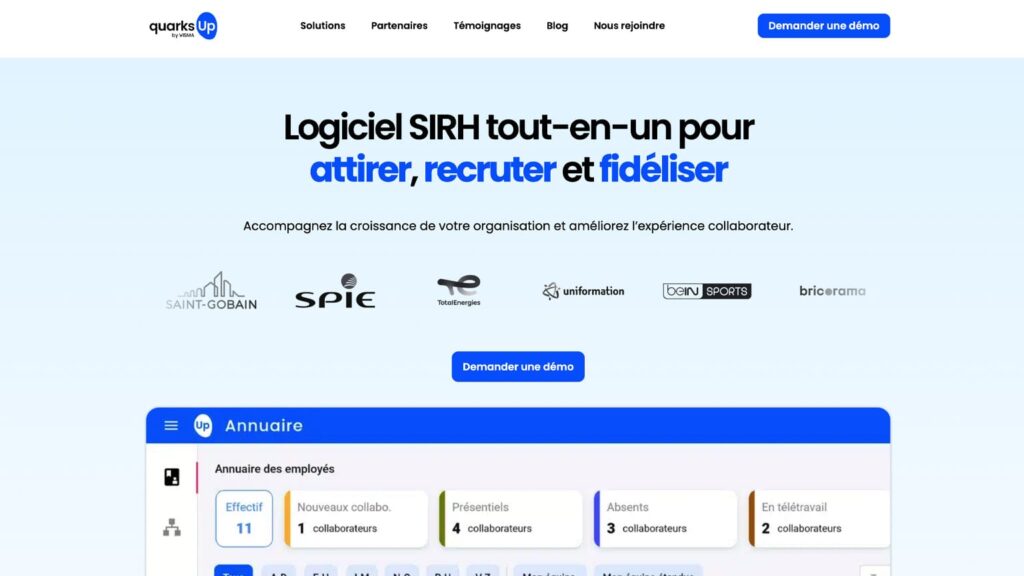
Designed for mid-sized companies, quarksUp treatsengagement as a separate HR management issue, rather than simply an indicator of workplace morale. The solution enables companies to conduct internal surveys and studies, analyze the results, and cross-reference them with HR data (career paths, internal mobility, training, interviews) to obtain a comprehensive and actionable understanding of engagement.
Beyond declarative measures, quarksUp relies on concrete signals from HR practices: career development, participation in training, mobility dynamics, and professional trajectories. HR teams and managers thus have clear and actionable indicators to identify areas of tension, prioritize actions, and drive long-term engagement.
This approach, combining studies, data analysis, and integration into the HRIS, promotes lasting engagement that is rooted in employees' daily lives and directly linked to managerial and organizational levers.
👍 Strength: combination of surveys, data analysis, and engagement management via HR pathways
👎 Weakness: less focused on isolated "pulse" tools than specialized solutions
→ DEMO: Discover how quarksUp measures employee engagement

Workday integrates engagement measurement into a comprehensive HR suite through employee surveys, analytical dashboards, and advanced data cross-referencing capabilities. Engagement is analyzed in relation to performance, retention, and internal mobility.
This approach allows for a detailed and predictive reading of social dynamics, particularly suited to large organizations with significant volumes of data. However, deployment remains cumbersome and requires a high level of HR and data maturity. For many SMEs and mid-sized companies, the functional complexity and associated costs can hinder actual use by teams.
👍 Strength: analytical power and predictive vision
👎 Weakness: complexity and limited accessibility for SMEs/mid-sized companies

BambooHR offers a simple approach to engagement, primarily based on employee surveys and accessible HR metrics. The tool allows you to conduct regular surveys, track overall trends, and provide visibility to managers.
This simplicity encourages adoption by SMEs wishing to structure an initial listening approach. On the other hand, the analysis remains relatively standard and not particularly connected to complex HR processes. The tool shows its limitations when attempting to link engagement, skills, and career paths.
👍 Strength: simplicity and speed of implementation
👎 Weakness: limited analytical depth and HR integration

Rippling takesa cross-functional approach to engagement, combining HR, IT, and data. Employee listening tools are based on both surveys and analysis of internal usage (onboarding, equipment, access to tools).
This comprehensive vision can provide valuable insights in highly digitized environments. However, HR engagement in terms of career paths, skills, and professional development remains secondary. For SMEs, this approach may seem excessive in relation to operational HR challenges.
👍 Strength: cross-functional and highly automated
👎 Weakness: HR management of engagement is not very structured

Bleexo is a tool specializing in measuring engagement through barometers, pulse surveys, and social climate analyses. It allows you to track changes in employee sentiment over time and identify weak signals.
This specialization is relevant for objectifying engagement, provided that there are managerial and HR representatives capable of transforming the results into concrete actions. Without strong integration with HR processes (training, mobility, interviews), the tool remains primarily a diagnostic tool.
[Note that Bleexo has been acquired by Silae]
👍 Strength: expertise in listening and engagement barometers
👎 Weakness: weak native link with operational HR levers

Teamupp focuses on team engagement, with tools for feedback, recognition, and managerial facilitation. The goal is to strengthen cohesion, communication, and a sense of belonging on a daily basis.
This localized approach is appreciated by managers, but it remains limited in terms of providing a comprehensive HR view of engagement. The tool is useful as a complement to an HRIS, but insufficient on its own to manage engagement across the entire company.
👍 Strength: commitment to proximity and team dynamics
👎 Weakness: macro HR vision and limited data

Qualintra offers toolsfor listening and qualitative analysis of engagement, often used in QWL and social climate initiatives. Surveys allow for in-depth exploration of employee perceptions.
This wealth of qualitative data is an asset for understanding expectations and irritants. However, the tool requires strong coordination with HR processes in order to generate a lasting impact. Without operational support, the results remain descriptive and difficult to act upon.
👍 Strength: detailed qualitative analysis of employee sentiment
👎 Weakness: limited transformation of results into HR actions
| Software | Targets | Approach to engagement | Strengths | Weaknesses | HR integration |
|---|---|---|---|---|---|
| 🥇 quarksUp | ETI | Engagement through HR practices and career paths | Behavioral insights (mobility, training, career path), actionable vision | Not very focused on isolated pulse surveys | ✔️ Native HRIS |
| 🥈 Workday | Large companies | Descriptive + predictive analysis | Analytical power, HR data cross-referencing | Complexity, heavy deployment | ✔️ Native |
| 🥉 BambooHR | SME | Simple surveys & HR indicators | Simplicity, rapid adoption | Limited analysis, little depth of insight | ⚠️ Partial |
| Rippling | Digitalized SMEs | Cross-functional HR/IT commitment | Automation, broader view of uses | Unstructured HR management | ⚠️ Partial |
| Bleexo | SMEs & mid-sized companies | Barometers & engagement surveys | Expertise in listening to employees | Weak native connection with HR levers | ❌ Limited |
| Team up | SME | Team & manager commitment | Managerial proximity | Limited macro HR vision | ❌ Limited |
| Qualintra | SMEs & mid-sized companies | Qualitative analysis & QWL | Detailed understanding of feelings | Complex HR transformation | ❌ Limited |
Before choosing a tool, it is essential to clarify what you are actually looking to improve. There are often multiple objectives, but they are rarely prioritized: reducing turnover, securing key skills, strengthening internal mobility, or better equipping managers.
In practice, the most effective projects are those that start with an identified HR problem (disengagement among employees, lack of prospects, managerial fatigue) rather than an abstract desire to "measure engagement." The software must serve a specific purpose, not a general intention.
Ergonomics is a prerequisite, but it is not enough. The criteria that really set a tool apart are its ability to integrate with the HRIS, cross-reference HR data (career paths, training, mobility), and produce actionable analyses.
An isolated engagement tool creates little value if it does not link findings to concrete levers for action. The customization of indicators and the clarity of reports are also crucial for engaging managers.
Commitment cannot be driven by one-off actions. Effective software is above all a tool that is used over time and integrated into HR and managerial routines.
In practice, adoption depends less on functional richness than on clarity of use: who consults the data, how often, and to decide what. Without buy-in from managers and without visible translation into HR decisions, even the best engagement tool quickly loses its impact.
Commitment measures long-term involvement, while experience covers the entire employee journey.
Measurement and analysis of engagement, tracking over time, segmentation by population/team/site, and ability to leverage verbatim comments to transform results into concrete HR actions.
Yes, and that is often the condition for moving from measurement to action.
Companies typically use multiple tools to cover all HR processes. Explore other specialized software solutions to effectively manage the various aspects of human resources.