









Skills management has become a key issue for HR departments. Faced with tensions in the job market, rapid changes in professions, and the need to anticipate rather than react, skills management software has become an essential tool. In concrete terms, it enables the identification of key skills, the measurement of gaps, the management of development paths, and the alignment of human resources with the company's strategy. By 2026, it will no longer be just another HR tool, but a real lever for management and anticipation.
In summary:
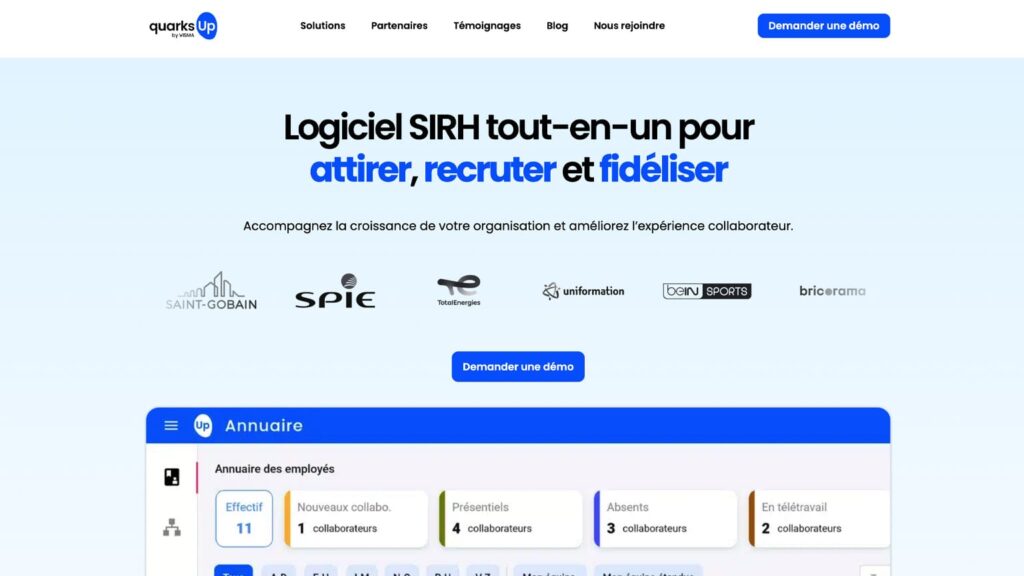
quarksUp offers a comprehensive, cross-functional approach to skills management, natively integrated into a complete HRIS platform. Unlike specialized tools, skills are not treated as a silo: they are linked to interviews, training, internal mobility, and HR management.
Job and skill frameworks are fully customizable, with clear and actionable proficiency levels. Data from professional interviews is directly fed into development plans and career paths.
In mid-sized companies, this approach makes it possible to move from theoretical GPEC to truly operational GEPP, managed over time.
👍 Strength: skills vision connected to the entire employee journey
👎 Weakness: requires initial framing to take full advantage of the skills/training links
→ Request a quarksUp demo... And discover how the software can help you manage your employees' skills.
Cegid HR has historically focused on talent and skills management for large organizations and structured groups. Developed from several functional components brought together over the years, the tool offers very broad coverage: skills frameworks, interviews, performance, training, mobility, and advanced HR management.
The solution enables large-scale GEPP processes to be structured, with powerful configuration and multi-entity consolidation capabilities. However, this wealth of functionality requires structured deployment projects, which are often lengthy and demanding in terms of internal resources or external support.
👍 Strength: functional power and steering capabilities
👎 Weakness: complexity of implementation for SMEs/small mid-sized companies
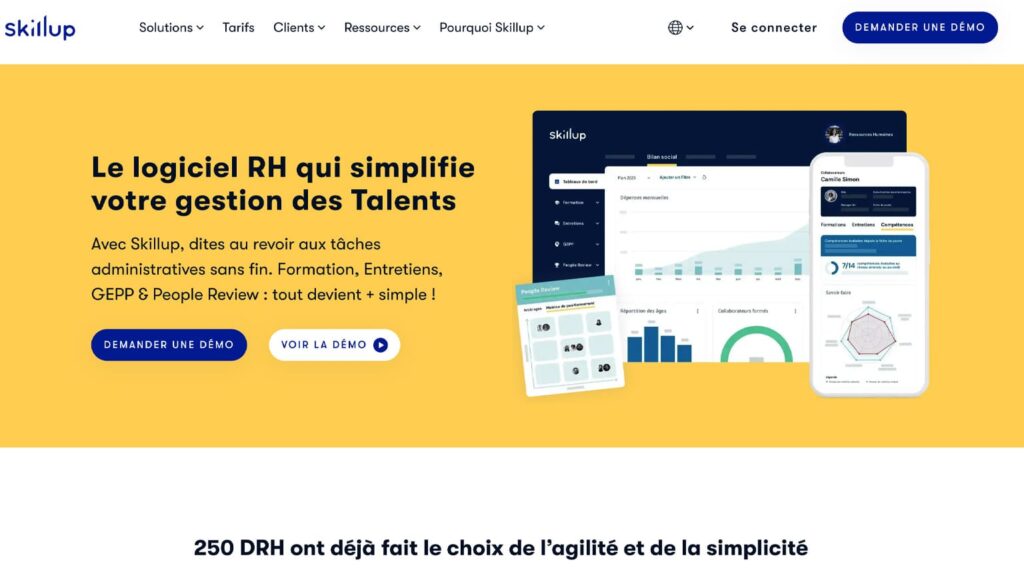
Skillup clearly positions skills management as a driver of development and upskilling. The tool closely integrates performance reviews, assessments, and training to translate on-the-ground observations into concrete upskilling plans. The skills identified during reviews directly inform individual and team development plans, fostering a culture of continuous learning.
The solution is particularly relevant for organizations that want to structure their training policy around the real needs of their business lines. However, this approach requires a minimum level of HR maturity and investment in the skills development process.
👍 Strength: strong consistency between skills, interviews, and training
👎 Weakness: less suitable for organizations looking for a very lightweight tool
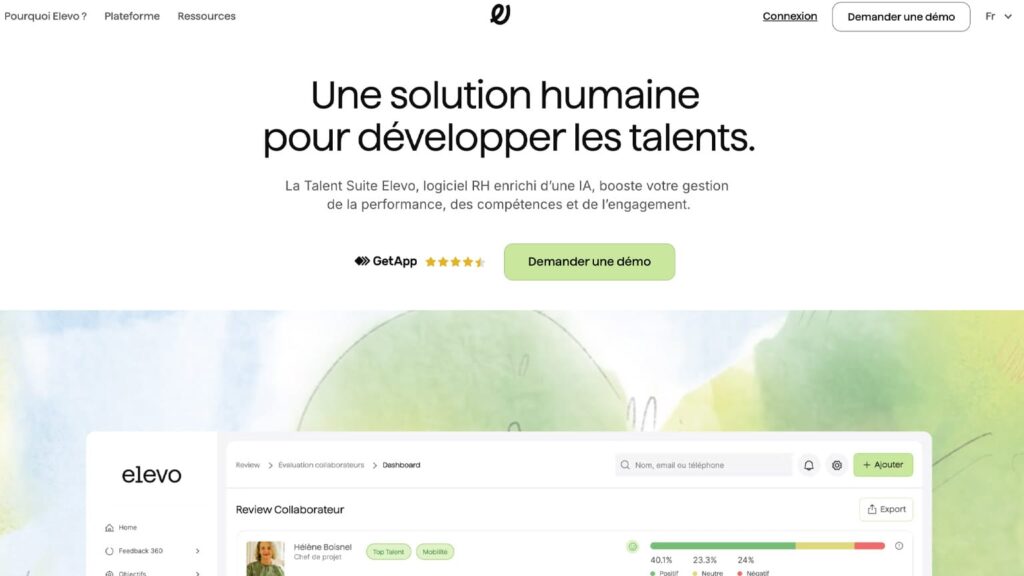
Elevo approaches skills management primarily through the lens of performance, continuous feedback, and managerial dialogue. Skills are tracked through performance reviews, goal-setting, and regular exchanges between managers and employees, fostering a culture of continuous improvement in the day-to-day workplace.
The tool is particularly appreciated for its ease of use and rapid adoption by managers, especially in organizations seeking to structure their management practices without excessive complexity. However, the view of skills remains largely focused on the individual. For comprehensive, cross-functional, and forward-looking skills management, Elevo often needs to be supplemented by other tools or integrated into a broader HR ecosystem.
👍 Strength: strong managerial adoption
👎 Weakness: Limited structured skills management without additional tools
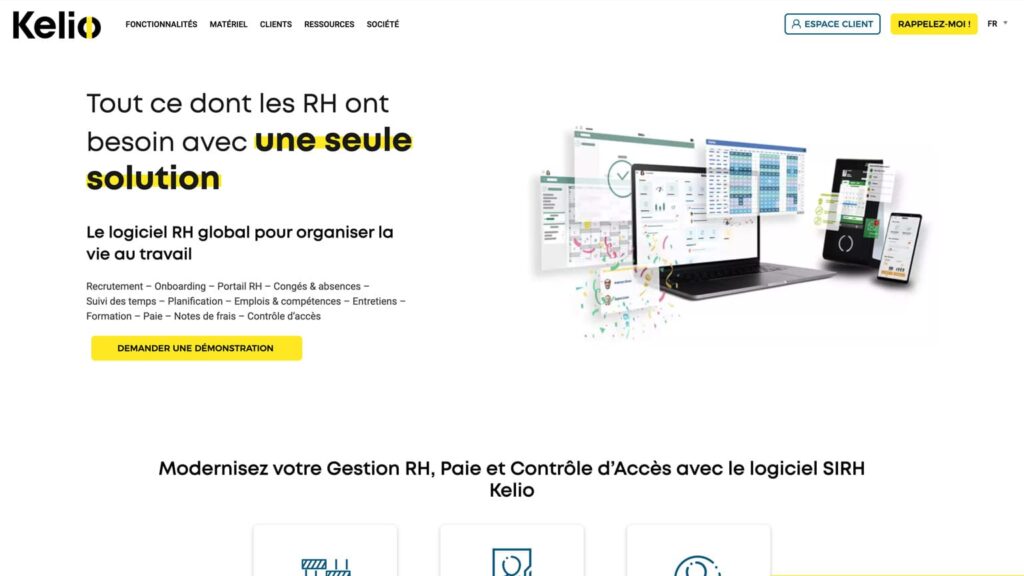
Kelio integrates skills management into an HRIS suite that has long been recognized for its time and attendance (T&A) and payroll management capabilities. The approach prioritizes compliance, data reliability, and process security, making it a popular choice in multi-site, industrial, or highly regulated environments.
Skills are monitored in a structured and traceable manner, particularly in relation to HR obligations and administrative data. However, the approach remains largely descriptive and operational. Skills projection, internal mobility, and anticipation of business needs are less central than in specialized GEPP tools.
👍 Strength: data compliance and reliability
👎 Weakness: vision of skills not very focused on projection and mobility
Septeo offers a skills and career management solution integrated into a comprehensive HR management system. The tool enables users to structure job and skills frameworks, create dynamic skill maps, and analyze gaps at both the individual and organizational levels.
The approach also incorporates a forward-looking dimension, helping HR departments anticipate changes in job roles, identify the skills that need to be developed, and secure career paths. Septeo is particularly aimed at organizations wishing to deploy a structured and consistent GEPP approach, especially in multi-entity environments.
👍 Strength: skills mapping and forward-looking analysis integrated into a structured HR framework
👎 Weakness: approach more focused on HR management than employee experience
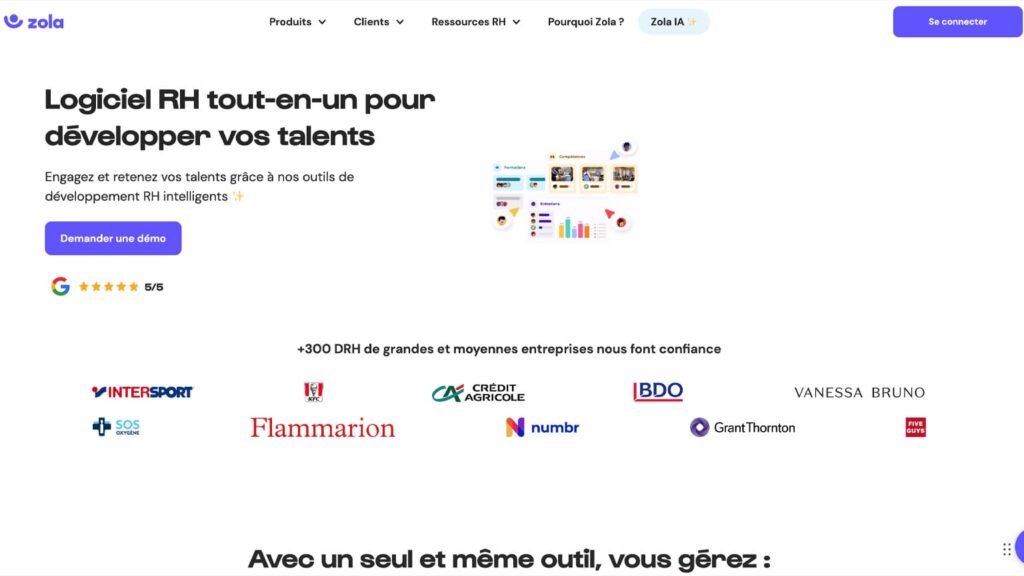
Zola is a tool specialized in skills management and career development, designed to bring clarity to areas where skills management often remains abstract. It stands out for its clear and accessible visual mapping, which allows users to quickly identify skills gaps, areas of weakness, and upskilling needs, both at the individual and organizational levels.
In practice, Zola is frequently adopted by SMEs or HR teams that want to structure a skills approach without immediately committing to a comprehensive HRIS project. The tool is a useful first step toward objectifying skills and initiating a management approach, provided that its integration with other existing HR tools is planned in advance.
👍 Strength: clarity of skills mapping
👎 Weakness: HRIS integration must be planned in advance to avoid double entry
| Software | Target | HRIS integration | Skills management | Positioning |
|---|---|---|---|---|
| 🥇 quarksUp | SMEs / mid-sized companies | Native | High | Employee journey |
| 🥈Cegid Talentsoft | ETI / Large corporations | Native | High | Talents |
| 🥉 Skillup | SMEs / mid-sized companies | Partial | High | Skills & training |
| Elevo | SMEs / mid-sized companies | Connectors | Average | Performance |
| Kelio | ETI | Native | Average | Regulatory HR |
| Septeo | SMEs / mid-sized companies | Native | Average | Compliance |
| Zola | SME | Partial | Average | Mapping |
Skills management software is not limited to storing information. It is an HR management tool capable of transforming heterogeneous data into decision-making levers. In many mid-sized companies, the mistake is to try to "map skills" without properly equipping the resulting uses. However, the value lies as much in building the repository as in its operational use.
The competency framework serves as the foundation for any competency-based approach. It helps organize job roles, identify key competencies (technical, behavioral, and managerial), and define the expected levels of proficiency.
In practice, the most effective frameworks are those that remain pragmatic and adaptable. If they are too detailed, they quickly become obsolete and unusable by managers. If they are too generic, they provide no operational value.
Good software allows you to:
For many organizations, formalizing the reference framework is already a first step toward clarifying HR.
Once the reference framework has been structured, the tool can be used to centralize existing skills, identify gaps, and visualize strengths and weaknesses, both individually and collectively. The skills matrices provide an immediate overview of areas of tension, critical skills, key dependencies, and business risks.
In growing mid-sized companies, these maps are often the primary tool for objectifying HR decisions, particularly during reorganizations, transformation projects, or key departures. Without a dedicated tool, this analysis remains partial, declarative, and difficult to use over time.
Competence cannot be decreed: it must be assessed, compared, and updated. Competence management software relies on professional interviews, annual reviews, self-assessments, and continuous feedback to fuel a dynamic vision of competence.
In many projects, interviews are conducted, but their results remain largely unexploited.
The tool allows these exchanges to be transformed into structured, comparable, and actionable data. When properly integrated, the interview becomes a central entry point for training, internal mobility, and talent management, rather than a simple regulatory obligation.
One of the key benefits of skills management software is its ability to link identified gaps to concrete actions. Training needs are no longer defined intuitively or on an ad hoc basis, but are directly derived from the skills that need to be developed.
The tool thus feeds:
In the most mature organizations, this approach makes it possible to move from "catalog" training to training driven by business challenges.
Today's most advanced solutions incorporate HR AI components. Their value lies not in automation for automation's sake, but in their ability to analyze large volumes of skills-related data.
Specifically, AI can:
In practice, these features are most useful in organizations that already have reliable, structured data. Without a solid foundation, AI remains more of a gimmick than a strategic lever.
Effective skills management software provides dashboards that can be used by HR and management.
Key indicators include:
Contrary to popular belief, having comprehensive mapping is not an end in itself. What matters is the ability to manage over time, arbitrate, and prioritize HR actions based on reliable data.
Stand-alone skills software loses much of its value. Without links to interviews, training, recruitment, and administrative data, information remains fragmented.
Integration with the HRIS enables:
In many projects, multiplying tools is a mistake. It is interoperability that transforms skills management into a real strategic lever, rather than a theoretical exercise.
GPEC software is not just a simple skills mapping tool. When deployed effectively, it transforms the way a company manages its human resources, anticipates its needs, and secures its career paths.
In many organizations, this is the shift from reactive HR to truly strategic HR.
In many companies, skills management still relies on Excel files, shared spreadsheets, or disparate documents that are updated on an ad hoc basis. The result: outdated data, duplicates, inconsistencies, and a considerable amount of time spent consolidating information before each HR decision.
Skills management software allows you to centralize all skills data in a single repository shared by HR, managers, and employees. Evaluations, interviews, training, and job rotations automatically populate the database, eliminating the need for manual data entry.
In concrete terms, this translates into:
In medium-sized companies, this time saving quickly becomes a critical issue as the workforce grows or the organization becomes more complex (multiple sites, multiple business lines, rapid growth).
When used effectively, skills management software significantly improves the employee experience. It makes career paths more transparent, expectations clearer, and career advancement opportunities more concrete. Employees know which skills are required for their role, which ones they already possess, and which ones they need to develop to advance.
This transparency plays a key role in engagement. It reinforces the feeling of recognition by valuing the skills acquired and efforts made to improve skills. It also facilitates discussions during professional interviews, which become structured moments of projection rather than formal exchanges.
In the most advanced organizations, software is becoming a tool for internal mobility: employees can position themselves for opportunities by understanding precisely what skills they need to acquire. Conversely, a lack of visibility on career paths remains one of the primary factors contributing to demotivation, as observed in internal surveys.
The structure of career development paths has a direct impact on employee retention. In many HR projects, we see that turnover is not solely linked to salary, but also to a lack of clear career prospects and recognition of skills.
GPEC software enables the creation of coherent career paths: career bridges, development plans, managerial or expert trajectories. This approach provides medium- and long-term visibility and reduces the feeling of stagnation.
In terms of attractiveness, having a structured skills development approach enhances the company's credibility with candidates. In a context of tension in certain professions, demonstrating that you are investing in skills development becomes a real competitive advantage. Organizations that can demonstrate structured career path management are more likely to attract candidates who are committed to long-term employment.
One of the key benefits of competency management software lies in its ability to go beyond a purely descriptive approach to jobs and competencies. It enables organizations to plan for the future by linking existing competencies to changes in job roles and the company’s strategy.
Thanks to consolidated dashboards, HR teams can:
In mid-sized companies, this ability to anticipate becomes a key lever for securing growth, supporting transformations, and avoiding HR decisions made in a hurry. Without a dedicated tool, GEPP often remains theoretical. With the right software, it becomes a real strategic management tool.
The choice of a skills management software solution is not based solely on the solution’s feature set. In most workforce planning projects, the gaps in value observed after deployment are due less to the tool itself than to a misalignment between the software, HR maturity, and actual usage. A sound choice therefore begins with a clear definition of needs, before comparing vendors.
There is no such thing as the "best skills software" for everyone. The right tool is the one that matches your current level of structuring and your medium-term goals, not necessarily the most advanced tool on the market.
Several factors must be analyzed beforehand:
In many small and medium-sized businesses, the first priority is to establish a common framework and ensure that performance reviews are reliable.
Conversely, in mid-sized companies, the challenges often revolve around multi-entity consolidation, identifying critical skills, and securing career paths.
Choosing a tool that is too advanced for the organization’s current level of readiness often leads to underutilization or even rejection.
A common mistake is to compare software based on an exhaustive list of features. A more effective approach is to evaluate each solution in terms of specific use cases directly related to the company's business challenges.
The key building blocks to be analyzed include:
In projects, we often see that the most effective tools are those that allow you to move quickly from analysis to action, without having to re-enter data or make manual decisions.
The success of a skills project depends heavily on user adoption. As such, the ergonomics of the tool and the quality of support play a decisive role right from the selection phase.
Skills management software must be usable by:
If the tool is perceived as complex or time-consuming, managers will bypass its use and the data will quickly lose its reliability. The most effective projects are those that integrate from the outset:
In many GPEC projects, it is not technology that is lacking, but rather change management. Good software, poorly supported, rarely produces lasting value.
By objectively assessing gaps and linking them to concrete action plans (training, mobility).
GEPP (Job and Career Path Management) is the modern evolution of GPEC (Forward-Looking Job and Skills Management). GEPP incorporates a career path dimension, placing greater emphasis on employability, mobility, and support throughout one's professional life, while maintaining the objective of anticipating skills needs.
By saving HR time, reducing turnover, developing internal mobility, anticipating critical needs, and improving employee satisfaction with the training courses offered.
In addition to these skills management software solutions, there are many other tools designed for specific HR functions. Discover other tools that can simplify employee management and HR processes: