









Providing better, faster, and more targeted training has become a strategic challenge for companies. Enterprise LMS software makes it possible to structure, deliver, and track online training courses, while providing visibility to HR teams and managers. By 2026, LMSs will no longer be simple content libraries: they will be integrated into the HR ecosystem to support onboarding, skills development, and compliance. Here is our comparison of the most relevant solutions for SMEs and mid-sized companies.
In summary:
An LMS (Learning Management System) is software that enables companies to create, deliver, manage, and track online or hybrid training courses. It centralizes educational content, learning paths, and progress data.
In business, an LMS is used to structure continuing education, support onboarding, secure mandatory training, and support skills development.
An LMS enables large-scale training deployment, standardization of practices, and measurement of participation. It improves traceability, reduces administrative burden, and provides a more seamless experience for employees.
When properly integrated, it becomes a lever for skills management rather than a simple content delivery tool.
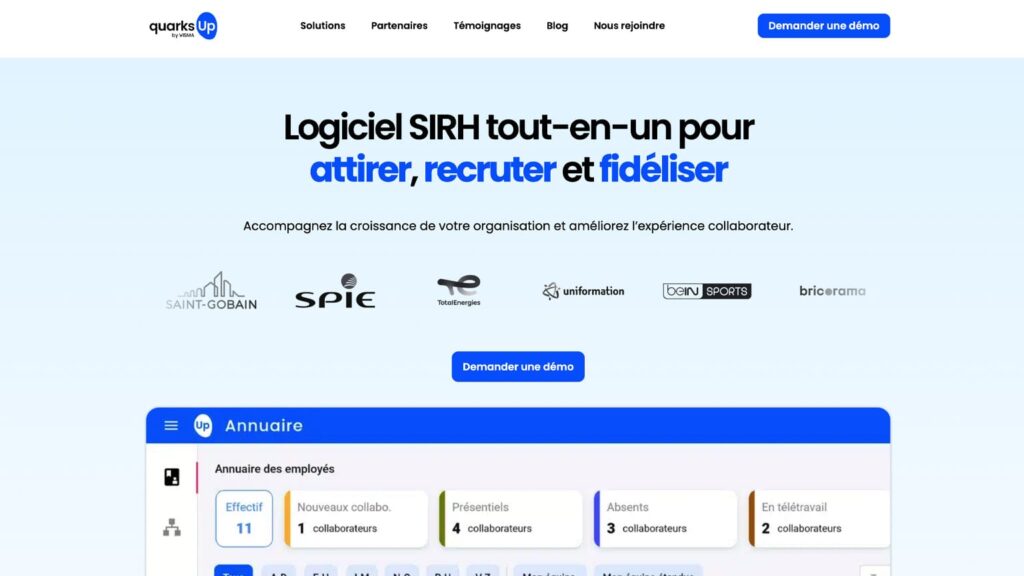
Designed for mid-sized companies, quarksUp is an all-in-one HRIS software solution that treats the LMS as a component supporting comprehensive skills management, rather than simply a tool for content delivery. The quarksUp LMS module manages all training programs (the e-learning component and the training component). It enables the structuring of training pathways aligned with job roles, expected competencies, and internal developments.
Training is integrated into a coherent framework that includes performance reviews, competency management, and career mobility. HR teams can track completed training paths, identify skill gaps, and prioritize training initiatives based on business priorities. Thanks to its modular approach, quarksUp adapts to the company’s digital maturity and facilitates gradual adoption by managers and employees, without unnecessary complexity.
👍 Strength: LMS integrated with HR management and career paths covering e-learning and classroom training
👎 Weakness: not very focused on catalogs of ready-to-use content
→ Discover the demo of the quarksUp LMS module

360Learning is a collaborative learning-oriented LMS designed to facilitate the creation and sharing of training content by internal teams. The platform focuses on short, interactive, and social formats to encourage learner engagement.
It is particularly suited to companies wishing to capitalize on internal expertise and quickly disseminate professional knowledge. However, LMS remains primarily focused on educational activities. HR skills management, structuring long career paths, and coordinating with interviews or mobility often require additional tools.
👍 Strength: learner engagement and collaborative creation
👎 Weakness: limited HR management and skills vision

Moodle is an open-source LMS known for its great functional flexibility. Thanks to a large ecosystem of plugins, it allows you to design highly personalized training courses that are adapted to many different contexts.
This richness makes it a powerful solution, but also a demanding one. In business, the deployment, maintenance, and evolution of Moodle require technical skills and dedicated support. Without clear governance, the tool can become complex to administer and difficult to evolve over time.
👍 Strength: high flexibility and customization
👎 Weakness: complexity of deployment and maintenance

Dokeos offers an LMS focused on professional training and compliance, with strong educational structuring capabilities. The LMS platform allows you to create organized courses, manage assessments, and accurately track learner progress.
It is well suited to companies with high requirements in terms of traceability, certification, or regulatory reporting. However, the user experience may seem more functional than modern, and integration with an HRIS or existing HR tools depends heavily on the technical context and the settings in place.
👍 Strength: pedagogical structure and regulatory compliance
👎 Weakness: variable ergonomics and HR integration

iSpring LMS is a solution designed for simplicity and rapid deployment. It makes it easy to deliver e-learning content, particularly thanks to its strong compatibility with office software, which allows you to quickly convert existing materials into training modules.
The tool is relevant for companies wishing to launch or industrialize online training without complex projects. However, advanced features for customizing courses, managing skills, or integrating with an extended HR ecosystem remain limited, which may hinder a more strategic approach to training.
👍 Strength: quick to learn and content distribution
👎 Weakness: limited strategic management and HR integration
| Software | Target | Positioning | Strengths | Weaknesses | HRIS integration |
|---|---|---|---|---|---|
| 🥇 quarksUp | ETI | LMS integrated into HR management | Skills-based career paths, links to interviews and mobility | Not very focused on catalogs of ready-to-use content | ✅ Native HRIS |
| 🥈 360 Learning | SMEs & mid-sized companies | Collaborative learning | Commitment, rapid creation of internal content | Limited vision, skills, and HR management | ⚠️ Partial |
| 🥉 Moodle | SMEs & mid-market companies with IT teams | Customizable open source LMS | Flexibility, functional richness | Technical complexity and maintenance | ⚠️ Via plugins |
| Dokeos | SMEs, mid-sized companies, regulated sectors | LMS compliance & professional training | Educational structure, traceability | More functional UX, variable integration | ⚠️ Depending on context |
| iSpring LMS | SME | Simple and fast LMS | Rapid deployment, office compatibility | Little strategic guidance | ❌ Limited |
An LMS allows you to structure training programs aligned with professions, positions, or operational objectives, rather than juxtaposing isolated content. This program-based approach promotes gradual, measurable, and consistent skill development. Market analyses show that the most mature companies are shifting from a "training catalog" approach to skills- and performance-oriented programs that are better suited to changes in the workplace.
Course customization involves adapting content or training paths based on the learner's profile, level, and results. The goal is not technological sophistication, butpedagogical effectiveness. HR trends highlight that employee engagement increases when training is perceived as useful, targeted, and directly related to their role, rather than generic or standardized.
Automation allows training courses to be assigned according to simple rules (position, job, skills, regulatory deadlines) and reminders or notifications to be sent without manual intervention. In SMEs and mid-market companies, this automation addresses a key challenge: reducing the administrative burden on HR so that teams can focus on management and support rather than execution.
LMS dashboards allow you to track learner participation, progress, and satisfaction.Content effectiveness is often measured through employee feedback, while the actual impact on skills requires a before/after assessment. As HR analyses remind us, training data is most valuable when cross-referenced with other HR data, particularly from interviews and skills management.
Integrating the LMS with the HRIS, collaborative tools, and videoconferencing breaks down barriers to training and allows it to be incorporated into broader programs: onboarding, compliance, and professional development.
Industry studies confirm that companies now favor integrated or modular HR ecosystems in order toavoid the proliferation of isolated tools and data silos.
The choice of an LMS depends above all on the context of the company: size, organization, training culture, and level of digital maturity. An SME in the process of structuring itself does not have the same needs as a medium-sized company that is already equipped. Market analyses show that LMS projects often fail when they are oversized in relation to actual usage and internal adoption capabilities.
An LMS must meet specific needs: onboarding, compliance, professional skills development, and internal knowledge sharing. Not all features are necessary from the outset.
HR trends emphasize one key point: a well-used tool creates more value than a feature-rich solution that is rarely adopted.
An isolated LMS severely limits the value of training data. Its integration with the HRIS determines the consistency of career paths, skills, and HR management.
The Xerfi study conducted in October 2024 , "The HRIS market in 2027, " highlights that the dynamics of the HRIS market are increasingly based on integrated or modular platforms capable of covering multiple HR uses without stacking tools.
The ergonomics of the LMS are crucial for its adoption by employees and managers. A tool that is perceived as complex or unintuitive will quickly be bypassed. The HR trends for 2026 remind us that the value of a digital tool depends above all on its actual use, much more than on its apparent functional richness.
Deploying an LMS is not just a matter of technical configuration. Team support, the solution's scalability, and data security are key criteria. Companies are looking for solutions that can evolve with their needs while ensuring compliance and protecting sensitive HR data.
The LMS focuses on the delivery and monitoring of online learning, whereas training software also covers administration and HR management.
Pricing varies depending on the number of users, features, and level of integration.
It allows you to link training, skills, and career paths, and to fully leverage HR data.
Human resources management often relies on a variety of specialized tools. Discover other HR software solutions designed to meet a range of needs: